
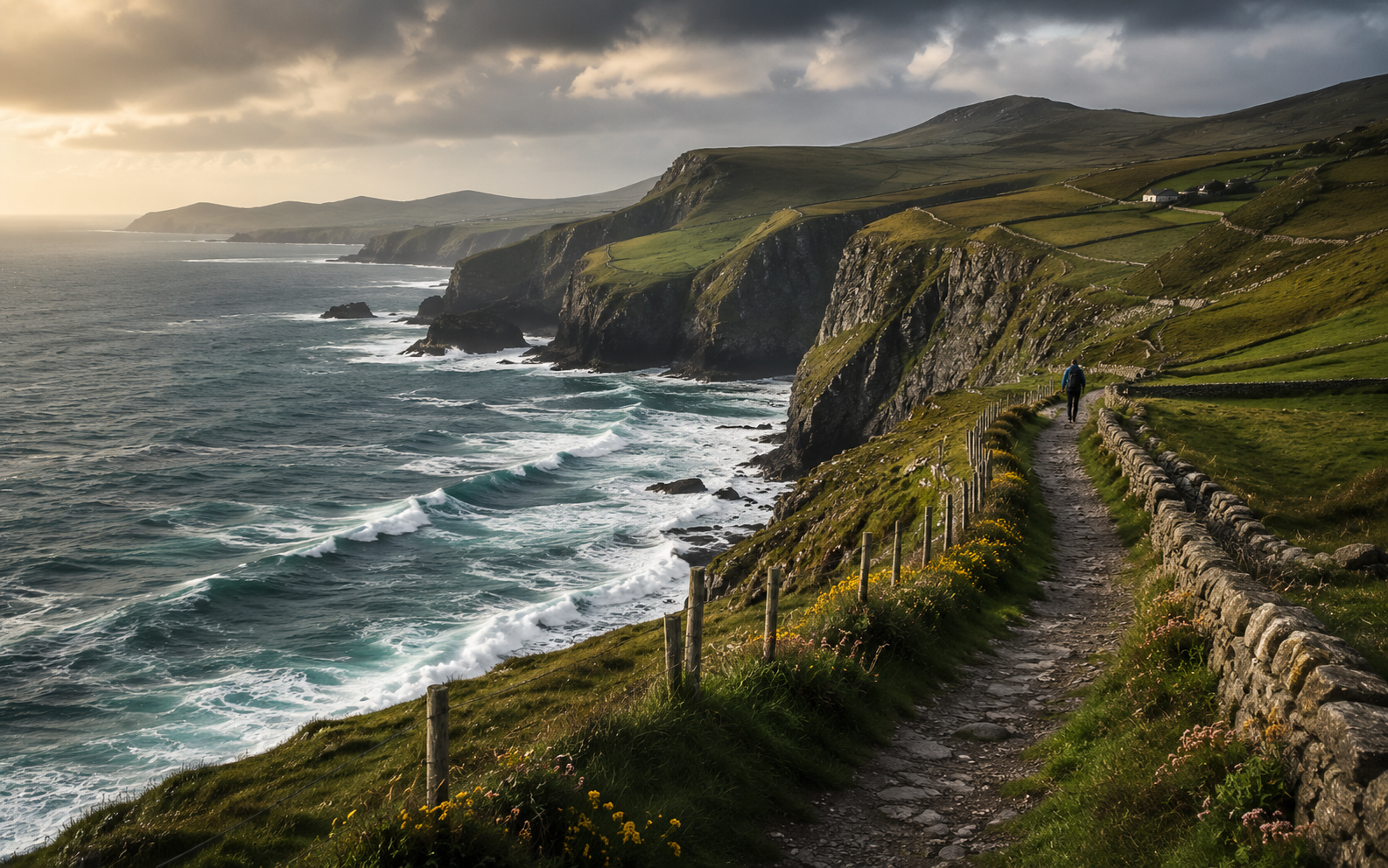
Ireland is a country made for walking. The scale is human — you can cross the island in a day by car, but the real Ireland reveals itself only at walking pace. The ancient trails that crisscross the landscape connect holy wells to ruined abbeys, cliff edges to hidden beaches, and the present to a past that's closer than you think.
The Wicklow Way
Ireland's oldest waymarked trail stretches 127 kilometres from the southern suburbs of Dublin into the heart of County Wicklow. The route climbs through the Wicklow Mountains, past glacial lakes and blanket bog, before descending into the gentle farmland around Clonegal. You can walk it in five to seven days, sleeping in B&Bs and hostels along the way.
What makes the Wicklow Way special is its proximity to the capital. Within an hour of leaving Dublin's streets, you're standing on open moorland with nothing but skylarks for company. The trail passes through Glendalough, a sixth-century monastic settlement nestled between two lakes, where round towers and Celtic crosses stand among oak and pine. It's one of those places where history doesn't feel like history — it feels like the present, just older.
The Wild Atlantic Way
Stretching 2,500 kilometres along Ireland's western seaboard, the Wild Atlantic Way is technically a driving route, but its best sections are walked. The Cliffs of Moher trail, the Sheep's Head Way in West Cork, the Beara Peninsula — these are landscapes that demand slowness. The Atlantic hammers the coast here with a violence that's both terrifying and beautiful, and the light changes so constantly that the same view looks different every hour.
Walking the western coast, you'll encounter stone walls that predate written records, abandoned famine villages slowly being reclaimed by grass, and pubs in tiny villages where you'll be the only visitor and the welcome will be immense.
The Pilgrim Paths
Ireland's oldest trails were walked by pilgrims. Croagh Patrick in County Mayo has been a pilgrimage site for over five thousand years — long before Christianity arrived. The ascent is steep and the scree near the summit is treacherous, but the view from the top, across Clew Bay's scatter of islands, is one of the great sights of Ireland.
St. Declan's Way follows a medieval route from Cashel to Ardmore, crossing the Knockmealdown Mountains. It's quieter than the famous trails, and all the better for it.
The Right Way to Walk
Ireland's weather is part of the experience. Expect rain, welcome it, and carry layers. The trails are well-marked but rarely crowded. Bring cash for the small-town pubs where you'll stop for soup and brown bread. Talk to the farmers whose land you're crossing — they'll tell you things no guidebook knows. And take your time. Ireland has been here for thousands of years. It's not going anywhere.